
Turning Everyday Questions Into Science For P1 To P3


“Why is the floor cold but the carpet isn't?” Your seven-year-old asks this at 7.15am, halfway through putting on a shoe, and you have roughly four seconds before the question evaporates. Most of us say something true and vague and keep moving, which is entirely reasonable on a school morning.
Those questions are the raw material for everything Science will later ask of your child, and they cost nothing. What follows is for parents of P1 to P3 children, and it is about turning the ones you do have time for into something closer to how a scientist thinks, with no kit and about ten minutes.
Science Becomes A Subject At P3
Before P3, Science is mostly absorbed. Children at P1 and P2 pick up ideas from stories and from the endless supply of questions they generate themselves. From P3 it becomes a subject with a syllabus, and the Ministry of Education (MOE) primary syllabuses run Science as one connected course from P3 to P6.
The shift catches some children out, and it has little to do with content. A P3 paper asks them to notice a difference and then give a reason for it, which is a different demand from simply knowing that plants need sunlight. Plenty of bright seven-year-olds can recite far more science than the syllabus expects and still stall on a question that shows them two plants and asks which one grew taller and why. Recall is not the skill being tested. Reasoning is.
The cheerful news is that noticing and explaining can be practised years earlier, in a kitchen, with no reference to a syllabus at all.
The Question Behind The Question
The trick with a child's question is to hand it back before answering it. “Why is the floor cold but the carpet isn't?” becomes “good question, what do you think?” and then, crucially, “how could we find out?” The second one does the work, because it moves a child from collecting an answer to designing a test.
Their first proposal will usually be unworkable, and that is fine. A six-year-old who suggests putting the cat on the floor to see whether it complains has understood something real about testing, even if the method needs refining. Steer gently towards something you can actually do before breakfast ends, and let them decide what to compare it against. Choosing the comparison is the part a P5 paper will eventually call a fair test, and a child who has been making that choice since P1 finds the term unremarkable when it finally appears.
Four Investigations You Already Have The Equipment For
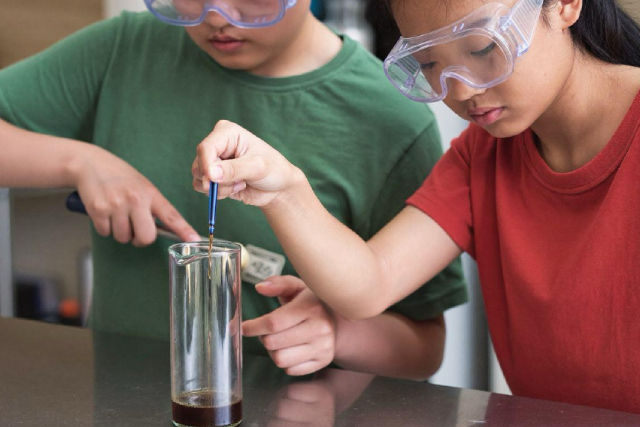
Each of these changes one thing and keeps everything else the same, which is the whole of fair testing at this age and the same principle behind the activities in most primary science workshops. An adult should do the peeling in the lemon test, nothing here needs heat or a flame, and nothing should be tasted.
Ice cube race. Two ice cubes, two saucers, one sitting on a metal tray and one on a wooden board. Which melts first, and why might that be?
The floating lemon. Put a whole lemon into a bowl of water, then a peeled one. The peeled one sinks, which is a genuinely surprising result and a good argument about what the skin is made of.
Shadow tracking. Chalk the tip of a lamp post's shadow on the pavement at 9am, at noon and again at 4pm, marking the time beside each cross. Ask what is moving, and be ready for a long answer.
Paper towel test. Two kinds of towel, the same amount of water, the same waiting time. Which holds more, and how would you make that test fair?
Let The Wrong Answer Stand For A While
The instinct to correct immediately is strong and generally unhelpful. A child who predicts that the peeled lemon will float, and then watches it sink, learns far more than one who was told beforehand. The surprise is the teaching.
Ask what they expected, and then what might explain the difference. Those two questions are, in miniature, exactly what an experiment report asks for at P5, and a child who has answered them fifty times over breakfast finds the formal version much less strange.
Small moments like these help kids cultivate an interest in science that survives the point where it becomes a subject with marks attached. That is a reasonable goal for the P1 to P3 years, and a more durable one than early drilling.
When A Class Adds Something Home Cannot
Kitchen science has limits. Some equipment is not domestic, some investigations need a bench and a sink, and most children behave differently doing science alongside other children than doing it with a parent. There is a particular kind of argument that only breaks out when four eight-year-olds disagree about what is going to happen next, and it teaches more than any tidy demonstration. Heuristics Science runs a P1/2 Science Explorer Lab and a P3/4 Science Olympiad Class alongside workshops that rotate through the year, so check the current listings or send an enquiry before planning around any one of them.
None of that replaces the morning question. A child who has spent three years being asked “how could we find out?” walks into P3 Science already fluent in the habit the subject most depends on.
Conclusion
The best preparation for primary Science looks almost nothing like schoolwork. It looks like a lemon in a bowl and an argument about why.
Ten minutes, once or twice a week, is plenty. The point is not the activity itself but the habit of guessing first and explaining afterwards, which is a habit that keeps paying out long after the lemon has gone in the bin.
If your child has reached the age where all this could use a proper bench and someone who knows the apparatus, Heuristics Science would be glad to hear from you. Come and see what a class looks like.



Comments