
What P6 Students Can Do In The Weeks After The PSLE

The last paper is handed in and the house changes overnight. The alarm goes off later, the folder of practice papers goes to the top of a cupboard, and a child who has been busy since January has weeks of free afternoons and no idea what to do with them. By about the second week, most parents are quietly wondering whether some of that time should be put to use.
It should, though probably not in the way the question implies. What follows is for parents of P6 students who have just finished the PSLE, and it looks at what these particular weeks are good for on the way into Secondary 1.
The Gap Is Longer Than It Feels
The Science paper was sat on Tuesday, 29 September this year, and the written examinations finished the following day, according to the 2026 PSLE examination calendar. Results are released tentatively between 24 and 25 November. The school year itself ends on 20 November, and Secondary 1 begins in the first week of January.
That is roughly three months, of which the first stretch is still term time with school programmes running, and the rest is holiday. Schools fill part of the post-examination period with activities of their own, so the free time is real but not unlimited.
Long enough to build something real. Far too long to spend revising for a subject that no longer exists in that form, and long enough that how it gets used makes a noticeable difference in January.
Nothing Needs To Be Fixed Right Now
There is a strong pull towards starting Secondary 1 content immediately, and it is usually a mistake. A child who works through Sec 1 Chemistry in November arrives in January having met the material in a vacuum, without the laboratory work or the teacher who makes it concrete, and often with a false sense of having done it already. There is certainly a place for lower secondary science tuition, and January is when it does the most good, once school lessons are running and there is something for it to sit alongside. The primary to secondary science gap sits mostly in habits and in the way questions are asked, and much less in content that can be loaded up over a holiday. Your child has just spent most of a year preparing for one examination. The most useful thing the next few weeks can do is give them their curiosity back.
What Actually Carries Over
Secondary Science asks for something primary Science only hints at, which is sustained written reasoning. A lower secondary answer often has to hold several steps together and show the link between them. That is a muscle, and it can be built on any material at all.
Reading is the cheapest way to build it. A child who spends part of these weeks reading science writing meant for general readers, on the body or the climate or on materials, arrives in January used to following an argument across a page. A library card covers most of this for nothing.
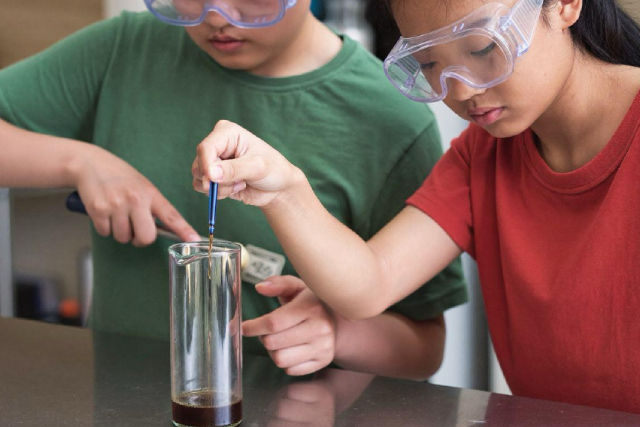
Practical skill is the other thing that transfers. Secondary Science involves apparatus from the first term, and a student who has handled a measuring cylinder and read a scale at eye level without help starts ahead of one who has only ever seen diagrams of both. Simple supervised experiments at home do this perfectly well, with goggles on, nothing heated and nothing tasted. Measuring out volumes of coloured water, timing how long a sugar cube takes to dissolve in cold water against warm, and recording both in a table is unglamorous and genuinely useful preparation.
Habits count too. A student who keeps a loose routine through December, waking at a reasonable hour and doing something with their head each day, finds the first week of January much less of a jolt than one who stops entirely for two months.
Ways To Spend The Weeks
What these weeks are genuinely good for, in rough order of usefulness:
Reading widely, including plenty that has nothing to do with school.
Learning a practical skill that involves following a procedure, such as cooking or building something from a kit.
Going somewhere that makes science physical, from a museum to a reservoir to a hawker centre where you can argue about why kopi cools faster in a metal cup.
Sleeping properly, which the past year has probably been short of.
Some families also use part of the window for a light introduction to secondary work, and there is a sensible version of that. A short course focused on how secondary questions are structured, instead of racing through a term of content, gives a student the shape of what is coming without spoiling it.
A Word About Posting Groups
Results arrive in late November and bring a decision about secondary schools with them. Under Full Subject-Based Banding, students are placed into Posting Groups 1, 2 and 3 instead of the former streams, and have greater flexibility to offer subjects at different subject levels as they move up the school.
For Science in particular, this means the group a child is posted to is not a verdict on the subject. Flexibility between subject levels is built into the system by design, and schools review how students are doing as they go. Details differ between schools, so the school itself is the place to ask once the posting is known.
That is a useful thing to say to a child out loud before the results arrive, because a number tends to land harder than it should.
Conclusion
These weeks do not need a programme. A child who reads, sleeps, makes something with their hands and keeps a loose rhythm will start Secondary 1 in better shape than one who spent November on a head start that quietly went stale.
When January comes and three sciences arrive at once, Heuristics Science is here to help your child find their footing. Get in touch to talk about what a first term of secondary Science support could look like.




Comments